
Understanding the Rights of First Amendment Auditors
This article examines the growing phenomenon of First Amendment auditors and the recurring legal missteps that occur when police detain or arrest individuals for openly recording in public spaces. Drawing on real-world incidents and decades of federal appellate precedent, the author explains how the First, Fourth, and Fourteenth Amendments protect the right of private citizens, not just credentialed journalists, to record police officers, public officials, and government activity in public. The analysis highlights common escalation points, including misapplied “suspicious activity” claims, unlawful demands for identification, and confusion over public versus private property, while emphasizing the critical role of supervisory judgment. Ultimately, the article challenges law enforcement professionals to align field practices with clearly established constitutional law to reduce civil liability and strengthen public trust.
Dr. Robert A. Verry, (Chief-Ret.)
1/5/2026
The Rise of First Amendment Auditors
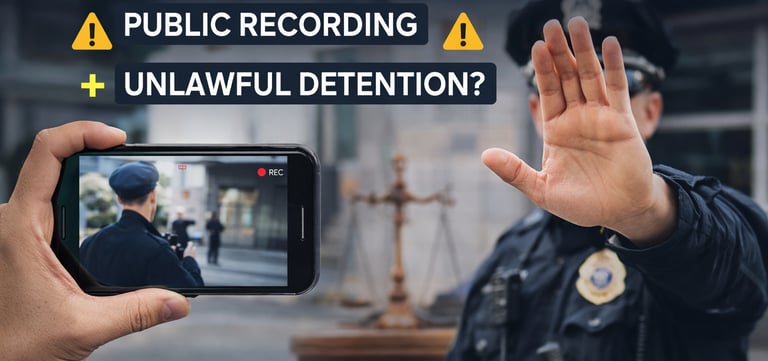
In recent years, the phenomenon of First Amendment auditors has gained substantial traction across America. These individuals routinely exercise their First Amendment rights by recording police officers and public officials as they perform their duties in public spaces. This activity, though seemingly straightforward, often leads to confrontations with law enforcement and raises significant legal questions regarding the rights of private citizens.
Legal Precedents and Citizen Rights
A pivotal element in understanding the rights of First Amendment auditors lies in the interpretation of various amendments to the U.S. Constitution. The First Amendment guarantees citizens the right to record public officials, including police, while they engage in their public duties. This right was not conferred solely on accredited journalists; rather, it extends to all individuals. Legal precedence established through numerous federal appellate court rulings reinforces this notion, underscoring the importance of accountability in government actions.
Common Missteps by Law Enforcement
Despite clear legal guidance, many police officers still exhibit confusion about the rights of those recording them. Common missteps include labeling "suspicious activity" when a citizen is simply filming in a public space. Additionally, unlawful demands for identification are typical, even when no crime is being committed. This confusion often leads to escalated encounters, in which officers may unlawfully detain or arrest individuals exercising their constitutional rights.
Both the public and law enforcement officials need to understand the distinction between public and private property, as misinterpretations can lead to significant legal disputes. When citizens are approached regarding their filming, officers must be informed on how to navigate these situations without overstepping legal boundaries. Knowledge of both the First and Fourth Amendments is vital in managing these encounters appropriately.
The right to record is, therefore, not merely an abstract principle; it is an essential tool for fostering transparency in government actions. As society continues to witness increased activity by First Amendment auditors, an improved understanding within law enforcement of citizens' rights is imperative. Education and training on these constitutional rights can prevent unnecessary confrontations and enhance mutual respect between citizens and law enforcement.